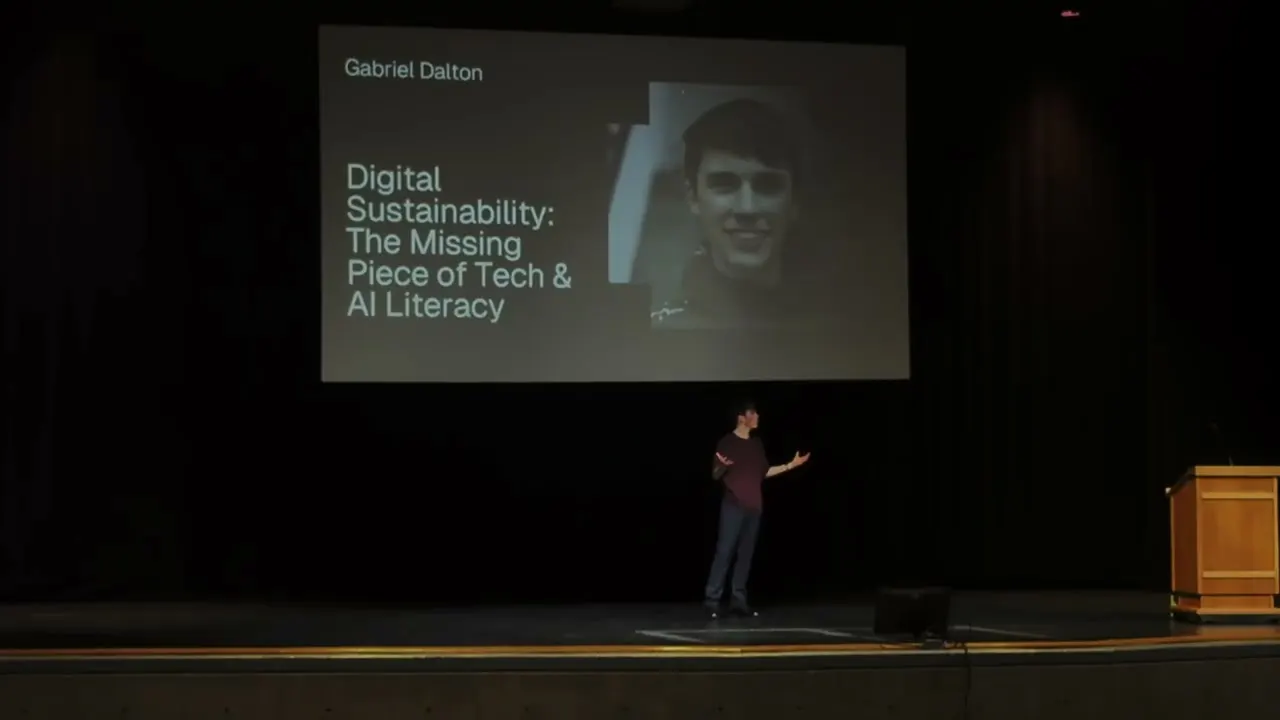
What the talk is about
I thought I was sustainable until I considered my digital footprint. In this talk, I explain how everyday online actions use energy and water and produce carbon emissions. I argue that digital sustainability belongs in AI and tech literacy. I share what I have learned through Oasis of Change and a framework anyone can use: learn, lighten and lead.
Key points
These are the claims and figures I present in the talk.
- A single Google search consumes about enough energy to power a 10-watt light bulb for 108 seconds. I put that alongside more than 5 trillion searches annually.
- A single ChatGPT request consumes nearly 10 times more energy than a simple Google search.
- The internet now roughly contributes to 3.7% of global greenhouse gas emissions.
- I cite Goldman Sachs Research: by 2030, data center power demand is expected to grow 160% at least compared to 2023.
- The average person's internet use produces about 230 kilograms of CO2 per year, roughly equivalent to driving a typical gas-powered car over 1,100 kilometers.
- My framework is to learn, lighten and lead: understand the costs, make intentional choices and share what you learn.
Chapters
- 0:12 The digital footprint I had overlooked
- 0:46 What an email costs
- 2:50 Digital sustainability and tech literacy
- 4:20 The environmental cost of AI
- 5:53 Growing demand and the education gap
- 8:24 Oasis of Change
- 10:30 Learn, lighten and lead
- 11:32 Lighten your digital footprint
- 12:15 Lead by sharing what you learn
- 14:45 The choice ahead
Full transcript
This transcript was proofread by hand against the recording.
I thought I was sustainable. My food choices, my travel methods, and even the clothes that I wear. I really thought I had it all figured out. But it surprised me to realize that there was one footprint I'd never considered before. My digital footprint. Well, if you're someone who brings your reusable bags when you go shopping or thinks twice before leaving the tap running, what I'm about to tell you might change your perspective on technology.
Take an email. That email is stored on a server. The server requires electricity to power. It generates heat. And it requires cooling.
Data centers that house those servers typically require millions upon millions upon millions of gallons of water a day. And the servers, well, they just sit there, running indefinitely. Multiply that by billions of people, billions of times, every single day. The phone in your pocket. It connects to a global digital infrastructure that produces more carbon emissions than the entire aviation industry.
We've been told that digital doesn't count. It's not real consumption, it's just the cloud. But the thing about the cloud is that it's not floating above our heads. It's a building. Actually, it's thousands of buildings the size of a shopping center, running full power, 24-7, all around the world.
We call the cloud like it's weightless, ethereal, which is great marketing, honestly, but the internet has math. It has infrastructure, and it has a carbon footprint. Later, when this TEDx talk is uploaded to YouTube, it'll be stored on the server somewhere. That server will be running, using electricity, generating heat, and every time someone else watches the same video, more servers, more power, more heat. And that's just streaming video. We haven't even started to discuss the impacts of artificial intelligence yet.
Today, I'm going to be talking about digital sustainability, the idea that our online actions have real-world environmental impacts and consequences. I believe it's the missing piece of AI and tech literacy that we're not talking about enough today. But I'm not just here to talk about a problem. By the end of this talk, I'm going to share with you a framework that I've developed over years of experience of how you can make a difference, even starting today. Three words. Learn, lighten, and lead.
But first, why does this all even matter? Well, here's the thing. We've become so technologically proficient that we forgot to ask ourselves one of the most basic questions. What does this all actually cost? Not in dollars, but in carbon, in energy, in water.
We scroll and we stream and we send, and we assume it's all consequence-free, or we conveniently forget. But it's not. A single Google search consumes about enough energy to power a 10-watt light bulb for 108 seconds. That's nearly two minutes. Now, that might not seem like a lot, but multiply that by more than 5 trillion searches annually, and suddenly we're talking about serious energy consumption.
Now let's talk about AI. Artificial intelligence has exploded over the past few years. Maybe even some of you here today are using it in your schools or your workplaces. Some teachers are even encouraging the use of artificial intelligence in computer classes. For their programming and coding projects.
I don't know what my teacher says, but here's what most people don't know. A single ChatGPT request consumes nearly 10 times more energy than a simple Google search. 10 times. AI is incredibly resource intensive. Training a single large language model consumes about enough energy to power hundreds of homes for an entire year.
So, when a teacher encourages the use of these artificial intelligence tools for students' AI or programming projects, how many of us are asking, or how many teachers are teaching about the environmental cost of doing so? But it's not just AI, it's literally everything we do online. The internet now roughly contributes to 3.7% of global greenhouse gas emissions, about the same as the entire United Kingdom. But that's just today, what about in 5, 10, or even 20 years?
Goldman Sachs Research estimates that by the end of the decade, so 2030, Data center power demand is expected to grow 160% at least compared to 2023. We're building a heavier, more resource-intensive web every single day, and most of us have no clue it's even happening. So why don't more of us know? Well, over my years being in this field, I've noticed a single consistent factor. A lack of education and awareness around digital sustainability.
Think about it. Have you ever heard the term low-carbon website? Maybe you have, but the reality is that most people don't have a clue about this problem, which is why it's still happening on such a massive scale. But I want you to imagine a different future. A future where my generation, Generation Z, and the generations to follow, expect corporations to have digital sustainability policies.
A future where we demand, where we advocate, because if enough of us do this, corporations will have to listen to our demands if they want our continued business, support, and even future employees, because we are the next generation.
But we can't demand what we don't understand, and we can't advocate for what we've never even been taught before. We've given an entire generation the tools to build incredible technology, but not always the awareness of what that technology actually costs the planet.
That realization changed everything for me. At the time, I'd been developing websites for a few years, until I came across that Google search and lightbulb statistic. And I took a moment to reflect. I said, wait, what if, what if I could combine the two? On one hand, websites, which I already have a bit of experience with, and on the other hand, sustainability, which is what I'm really curious about. What if websites could be part of the solution to this problem?
So in March of 2024, I founded Oasis of Change, a federal not-for-profit corporation based in Vancouver, Canada, to prove that this is possible at scale. And since our incorporation nearly two years ago, we've worked on website projects that have reduced carbon emissions, energy use, and water use by up to 98%. And we've planted over 9,000 trees across 18 countries, offsetting carbon while we work to reduce it at the source. And by the end of this month, we'll have planted a few thousand more trees in eight additional countries, including Ireland, Canada, Australia, and France. Regarding AI, I had the opportunity to participate in a hackathon hosted alongside Microsoft, where a team and I developed a proof-of-concept solution for a sustainable cooling method in AI data centers.
That experience is pretty fun. However, those two experiences taught me something really important, that solutions don't matter. If people don't understand, there's an issue with this in the first place. So I worked with the city of Vancouver to officially proclaim Sustainable Technology Week. An entire week dedicated to digital sustainability, October 20th to October 27th.
Signed by Mayor Ken Sim. And that taught me that this conversation is starting to gain traction. We're starting to see change happen. Cities like Vancouver are now officially recognizing and even celebrating work in the digital sustainability field. But now the question is, how do we ensure that this traction stays there? How do we ensure that this conversation is still at the forefront of our discussions?
Through all this work, I've come up with a simple, three-step framework that anyone can use to start making a difference, even today. I call it the three L's. Learn, Lighten, and Lead. This is the exact framework that Oasis of Change uses, and it's how we achieve that 90% reduction in website emissions on that single nonprofit project. The first step is to learn.
Educate yourself about digital sustainability. Understand that our online actions have real-world environmental consequences. Start asking questions like, what's the environmental cost of this AI tool I'm using? Are there more sustainable alternatives? Does this tool provide sustainability reports?
Or could I use a simple Google search to find a valid answer, rather than using AI, which uses 10 times more energy? The second step is to lighten. The second step is about making intentional choices to actively reduce your digital carbon footprint. For example, delete old emails. And if you're someone whose inbox says 9,999 plus, well, then this is your sign.
Unsubscribe from newsletters you don't even read. When you're watching a video and you don't need 4K, switch it to standard. Use AI intentionally, not for every small task that a search engine could handle.
Step three, lead. Share what you've learned. If you're a teacher, integrate this into your curriculum. If you're a developer, actually develop sustainable websites. If you're a parent, educate your children that streaming their favorite TV show and movie and playing their favorite video game actively contributes to their digital carbon footprint.
If you're a consumer, question corporations about their digital sustainability policies. Why does this all even matter? Well, the average person's internet use, just scrolling, streaming, and sending, produces about 230 kilograms of CO2 per year. That's roughly equivalent to driving a typical gas-powered car over 1,100 kilometers just from being online.
But now, imagine if one teacher shares this with 30 students. Those 30 students, they go home, they talk to their families. Suddenly, a single classroom has created a ripple effect that reaches potentially hundreds of people, all slightly making more intentional choices. And you don't have to be a tech expert to start. You simply just have to care.
At the start, I told you that I thought I was sustainable. Well, now you know what I didn't. And what I would argue is that still many people around the world today still forget and overlook on a daily basis. That being sustainable isn't just about your diet. Or how you get to and from work, or even if you wear 100% cotton clothing.
But it also includes your digital actions. Because when you see numbers like 108 seconds, five trillion searches a year, that number is only estimated to increase. And 160% energy increase demand. Now that, multiplied by billions of people, billions of times, every single day. It all adds up. Our collective digital behavior actually matters.
The internet is not going away. And technology will only become more central to our lives. Artificial intelligence is only going to continue to evolve and grow at rates never seen before. But right now, in 2026, we have a choice to make, and a very important one. Will we continue pretending that the internet is like magic?
Invisible, weightless, consequence-free? Or will we teach digital sustainability as a core part of tech and AI literacy? If we teach this now, we raise a generation that's not just technologically proficient, but one that's also responsible with their power use and educated about their digital carbon footprint. So that we can continue living as a prosperous species on this amazing planet. Thank you.
For booking, see my speaking page. Read my note on preparing this talk.